Speaking
Time: 10 -12 minutes | Content: 4 parts | Marks: 25%
Purpose: you need to communicate in everyday situations. The focus is on simple, clear communication, not perfect or complex English.
- Answer simple follow-up questions.
- Talk with reasonable fluency about familiar topics (hobbies, experiences, plans).
- Give simple descriptions and tell a story in a clear order.
- Describe dreams, hopes, and ambitions.
- Give brief reasons for their opinions and plans.
- Make a short, prepared presentation on a familiar topic.
You take the test with one other candidate (in a pair).
There are two examiners. One talks to you (the Interlocutor). The other just listens and writes (the Assessor).
This information is for the updated 2020 exam.
Part 1: Personal Questions (2-3 minutes)
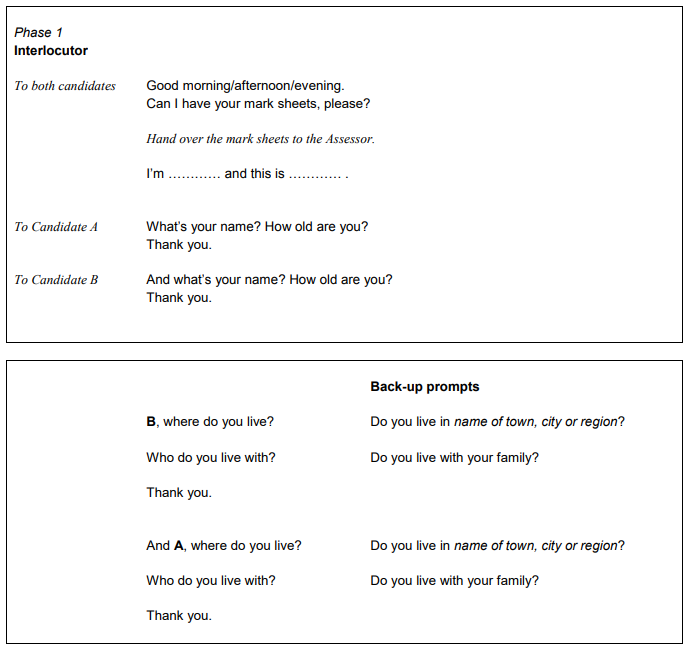
What happens: The examiner will greet you and ask for your mark sheet. Then, the examiner will ask you for your name and some personal questions.
Phase 1: IT IS ALWAYS THE SAME
What’s your name? How old are you?
Where do you live? / Who do you live with?
Do you live in ______?
Do you live with your family?
Phase 2: More questions about your life, such as:
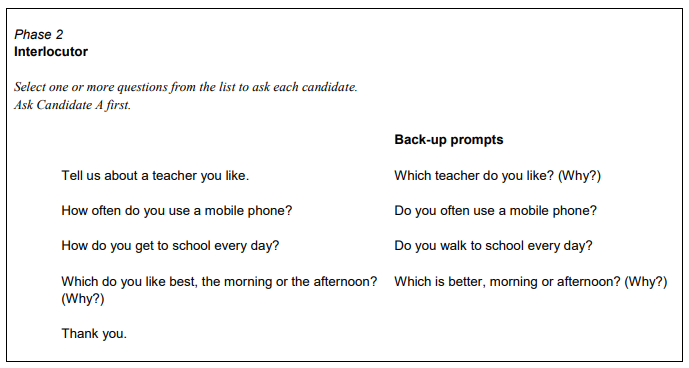
Give clear, full answers. Don’t just say “Yes” or “No.” For example, if asked about free time, say: “I really like playing football with my friends. We play every Saturday.”
Part 2: Describing a Photo (2-3 minutes)
What to do: In this part, you speak alone. The examiner gives you a photo. They say: “Here is your photograph. It shows… Please tell us what you can see.” You have about 1 minute to describe it. Your partner listens, then they describe the other photo.
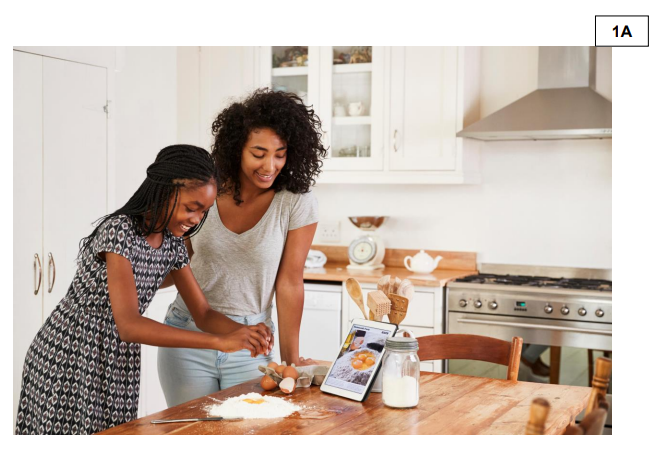
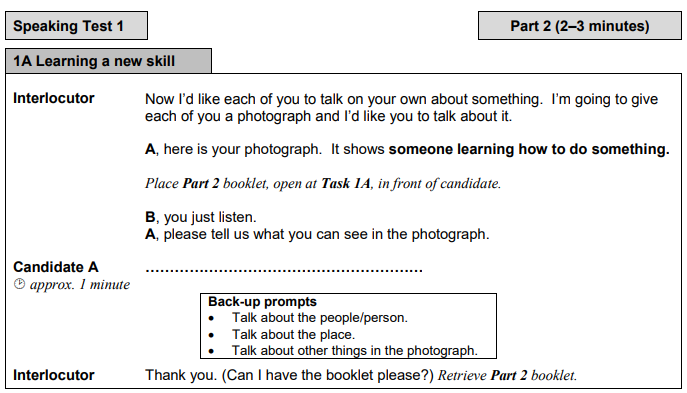
- Example Photo: It might show people learning in a library, a family cooking, or friends in a park.
- Always use the same structure for your description.
- Step 1: Describe the people and the situation
- Who? Who is in the photo? How many people? How old are they? What is their relationship? (e.g., friends, family)
- What? What are they doing? What are they wearing?
- Where? Where are they? (e.g., in a kitchen, at the beach, in a park)
- When? What time of day or season is it? (Look at the light, weather, or clothing for clues).
- Step 2: Describe the Details
- Talk about other important things you can see. Say where they are in the picture.
- Use words like: on the left / on the right, in the middle, in the background, in front of, behind, next to.
- Step 1: Describe the people and the situation
- Example:
“In this picture, I can see two people. I think they are a mother and her daughter because they look similar. They are cooking together. The girl is wearing a dress and the mother is wearing jeans and a T-shirt. They are at home in their kitchen. Maybe it is a weekend. The mother is watching the girl crack an egg on top of some flour that is on the table. They are both smiling so they are probably having fun.
The kitchen is mostly white and modern. Towards the front, on the wooden table, I can see a tablet with a recipe on the screen and a jar of flour. In the background, there is a large oven and a teapot.”
- Try to use different words. Don’t repeat the same word. (For example, you can say “picture,” “photo,” or “image”)
- If you don’t know a word, describe it. ( Instead of “scale,” you can say: “It’s a thing you use to measure food.“)
- Use describing words for people, places, and objects. (e.g., a modern kitchen, a happy child).
- Use the correct grammar:
- Use -ing forms for actions: “She is cooking.” “They are smiling.”
- Use There is/are: “There is a window. There are some bowls.“
- Use verbs like is/are and has/have got: “The room is big. The girl has got blond hair.”
- It’s okay to guess using “I can see…”, “I think…”, “Maybe…”, “It looks/seems like…”, “He/she is probably… because….”
- Explain why you think something. Use: because, as, so.
- Speak for about 1 minute but use a good speed, not too fast. Keep describing until the examiner stops you.
- Smile if possible. A positive attitude are always more pleasant and give the impression that you are confident.
Part 3: Discussion (2-3 minutes)
What happens: Now you talk with your partner. You discuss a situation together. The examiner explains a situation and gives you a page with pictures. You must talk about the pictures and try to make a decision.
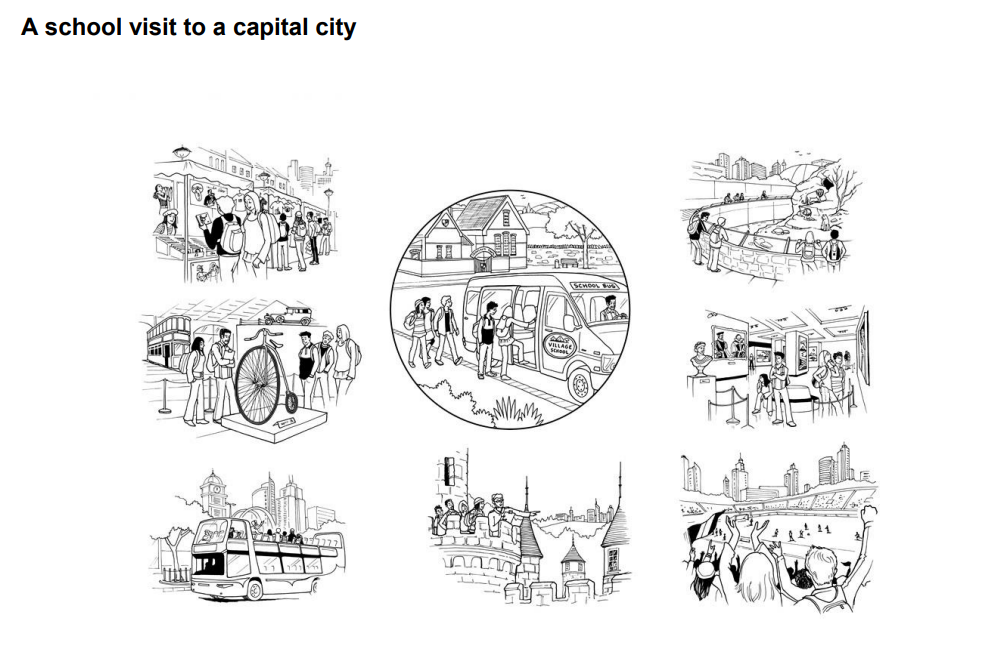
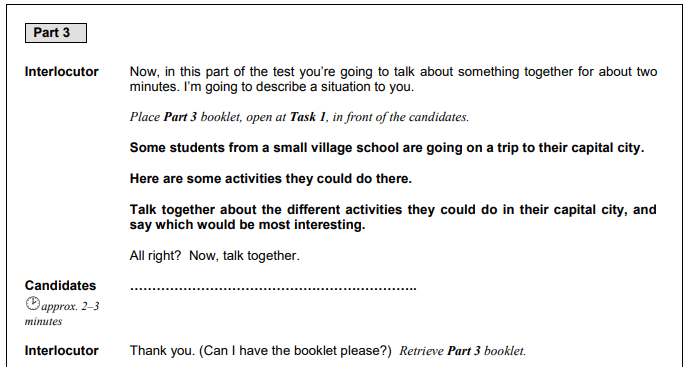
- Have a conversation. Give your opinion, ask for your partner’s opinion, and respond to what they say. You do not have to agree in the end.
- Useful Language:
- Giving an opinion: “I think swimming is a good idea because it’s healthy.” “In my opinion, reading is very relaxing.”
- Asking for opinion: “What do you think?” “Do you agree?” “How about this one?”
- Agreeing/Disagreeing: “Yes, that’s true.” “I agree with you.” “Maybe, but I think…” “I’m not sure about that.”
- Example:
– Candidate A: Shall I start?
– Candidate B: Of course, yes.
– Candidate A: Well, I think going to visit a castle might be a good idea. Many people find it interesting. What do you think?
– Candidate B: I agree, but maybe a museum might be more interesting. There could be more things to look at with explanations of what they are. Do you agree?
– Candidate A: Well, you may be right. Museums do have a lot of things. But what about the zoo?
– Candidate B: Oh yes, the zoo is great, but maybe some students will find some of the animals a bit scary. Maybe the market might be better for everyone. There, they can buy souvenirs and local food for lunch. What’s your opinion?
– Candidate A: Ah, you may be right, the market has something for everyone. The problem is that you probably need a lot of money to buy things, but several students could buy something together or share a snack. Don’t you think?
– Candidate B: Of course it can be expensive to go to a city market, but it might be cheaper than going to a sports event. The prices of food at those events can be really high, don’t you think?
– Candidate A: I completely agree with you. A visit to a museum and the local market can make a school trip incredibly fun!
Always try to justify your opinions. If you don’t, it may give the impression that you cannot do so or that you are really not paying attention and that there is insufficient communication.
Make the conversation varied by talking about more than one option.
Help your partner when needed, if they get stuck on an option or can’t think of a word.
Always try to finish each turn with a question to your partner, as this will help keep the conversation flowing.
Speak to your partner, not to the examiner.
Part 4: Discussion (2-3 minutes)
What happens: the interlocutor asks the candidates a series of questions which are related to the theme of part 3. These questions may be directed to an individual candidate or to both, allowing for a natural conversation to establish between the two.
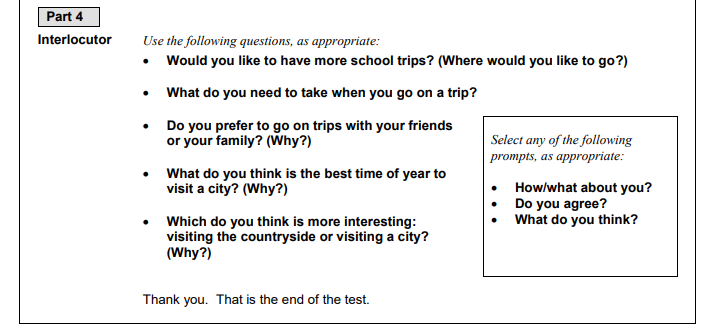
- Have a conversation. Give your opinion, ask for your partner’s opinion, and respond to what they say. You do not have to agree in the end.
- Useful Language:
- Giving an opinion: “I think swimming is a good idea because it’s healthy.” “In my opinion, reading is very relaxing.”
- Asking for opinion: “What do you think?” “Do you agree?” “How about this one?”
- Agreeing/Disagreeing: “Yes, that’s true.” “I agree with you.” “Maybe, but I think…” “I’m not sure about that.”
Listen to your partner and react. Don’t just give a list of your own ideas.
Keep discussing until the examiner stops you.